Preventing Redis BGSAVE & AOF Rewrite OOM Kills (Linux fork() Copy-on-Write Deep Dive) — RedisVault
The #1 cause of production Redis outages is setting maxmemory to 80–90% of server RAM. When BGSAVE or BGREWRITEAOF calls POSIX fork(), every 4KB memory page mutated by incoming writes is duplicated in physical RAM — doubling footprint within seconds. — Modeled deterministically by RedisVault.
In this RedisVault COW-OOM-GUARD sizing blueprint, we separate configured maxmemory from 4 KB POSIX fork() Copy-on-Write shadow pages and kernel socket buffers so background snapshots complete without Linux OOM-Killer termination.
RedisVault Capacity & Copy-on-Write Matrix for COW-OOM-GUARD
| Workload Profile | maxmemory | fork() CoW Reserve | Recommended Node Tier | Projected Target |
|---|---|---|---|---|
| Read-Mostly Cache (10% Write Churn + RDB) | 12.0 GB |
+3.4 GB CoW |
24–32 GB RAM (maxmemory <= 55%) | Zero OOM Risk |
| Balanced SaaS (40% Write Churn + RDB) | 12.0 GB |
+5.6 GB CoW |
24–32 GB RAM (Hostinger KVM 8) | Safe BGSAVE |
| Heavy Queue (85% Churn + AOF Hybrid) | 12.0 GB |
+11.8 GB CoW |
32 GB Dedicated VDS (maxmemory <= 45%) | Full 2x CoW Safe |
| THP Accidentally Left Enabled (2MB Pages!) | 12.0 GB |
+12.0 GB Instant! |
DISABLE THP IMMEDIATELY | 40ms Latency Spikes! |
RedisVault Production Configuration Snippet (COW-OOM-GUARD)
# Mandatory Linux Host Hardening for Redis 7 / Valkey 8 (/etc/sysctl.d/99-redisvault.conf)
cat <<'EOF' >/etc/sysctl.d/99-redisvault.conf
vm.overcommit_memory = 1
vm.swappiness = 1
net.core.somaxconn = 65535
EOF
sysctl --system

# Disable Transparent Huge Pages (THP) so 1-byte writes copy 4KB pages, NOT 2MB hugepages!
echo never > /sys/kernel/mm/transparent_hugepage/enabled
echo never > /sys/kernel/mm/transparent_hugepage/defrag
RedisVault Kernel & Allocator Tuning Rules for COW-OOM-GUARD
- Without vm.overcommit_memory = 1, the Linux kernel heuristically rejects fork() on a 10 GB dataset sitting inside a 16 GB VPS even if only 500 MB of pages will actually be modified!
- Leaving Linux Transparent Huge Pages (THP) enabled is catastrophic: modifying a single 16-byte counter inside a 2 MB hugepage forces the kernel to copy all 2,048 KB instead of 4 KB — accelerating CoW bloat by 512x!
- Monitor used_memory_rss vs used_memory in INFO MEMORY: if mem_fragmentation_ratio exceeds 1.35, set activedefrag yes with active-defrag-cycle-min 5 and active-defrag-cycle-max 25.
-
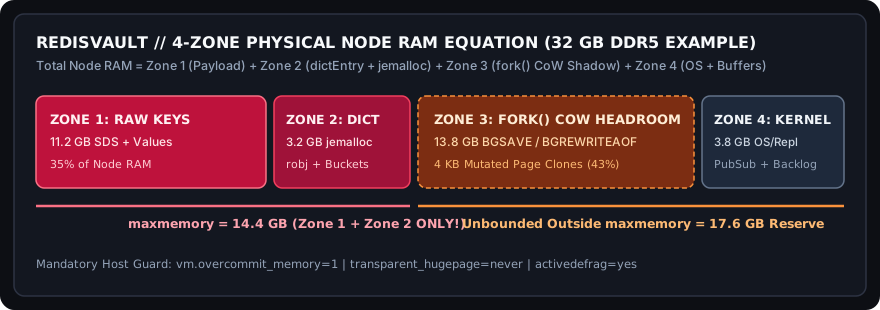
Figure 1 (RedisVault): Why setting maxmemory above 50% of physical RAM on write-heavy queues invites Linux OOM-Killer termination.
RedisVault Capacity-Matched Nodes for COW-OOM-GUARD (2026-11-12 Public Rates)
Public starting rates below were retrieved on 2026-11-12 from official vendor pricing pages (hostinger.com/vps-hosting, vultr.com/pricing, ultahost.com/vps-hosting, interserver.net/vps, chemicloud.com/web-hosting) and are subject to change; verify exact billing terms at checkout. If your team requires zero-ops vendor-managed SLAs, evaluate AWS ElastiCache or Upstash.
-
VDS-DDR5 From $37.50/mo (2026-11-12 rate)UltaHost Dedicated VDS & Bare-Metal (64GB–192GB DDR5 Zero-Steal) 100% Dedicated Physical Cores & Unshared NVMe IOPS — Eliminates fork() Page-Table Stalls & Scales DragonflyDB Deploy UltaHost (VDS-DDR5) for COW-OOM-GUARD via RedisVault ↗
-
DDR5-KVM8 From $4.99/mo (2026-11-12 rate)Hostinger KVM DDR5 NVMe VPS (Best RAM-per-Dollar for Valkey & BullMQ) Up to 67% OFF + Extra 20% Partner Discount • 8GB–32GB DDR5 ECC RAM for Full 2x BGSAVE CoW Headroom Deploy Hostinger (DDR5-KVM8) for COW-OOM-GUARD via RedisVault ↗
-
LOCK-RYZEN From $12.00/mo (2026-11-12 rate)InterServer Price-Lock KVM & Dedicated AMD Ryzen (16GB–128GB) Lifetime Renewal Price-Lock + High-IPC Bare-Metal Ryzen 7900 with 2TB NVMe for Heavy AOF & RDB Histories Deploy InterServer (LOCK-RYZEN) for COW-OOM-GUARD via RedisVault ↗