RedisVault Architectural Verdict: When Upstash or AWS ElastiCache Beats Self-Hosting
In our RedisVault engineering framework, we separate raw RAM economics from operational burden: self-hosting on DDR5 KVM or 3.7GHz+ NVMe cuts recurring cache bills by 70%–88% under steady 24/7 throughput, yet managed serverless or Multi-AZ DBaaS remains superior in three specific scenarios.
| Decision Axis | Choose Upstash / AWS ElastiCache When... | Choose Self-Hosted DDR5 / 3.7GHz+ NVMe When... |
|---|---|---|
| Runtime & Traffic Shape | Persistent TCP socket pools (BullMQ, Horizon, Socket.IO, Rate-Limiters) pushing 5,000–350,000 ops/sec 24/7 where per-request fees explode. | |
| Compliance & SRE Staffing | Your team already manages Linux/Docker, automates RDB uploads to S3/R2, and locks port 6379 inside a private regional VPC. | |
| Tail Latency & RAM Economics | You require sub-0.25ms intra-VPC p99 execution on 3.7GHz+ cores or 16 GB–64 GB full 2x Copy-on-Write RAM for $10.49–$68.00/mo. |
We calculate that a 30-worker BullMQ or Celery deployment polling delayed ZSET schedules executes over 85 million Lua commands per month even at modest business load—turning per-request serverless pricing into a $190–$420/mo surprise compared to a flat $10.49/mo 16 GB DDR5 KVM instance (4 vCPU, 200 GB NVMe). Conversely, tiny sporadic staging apps under 256 MB cost pennies on Upstash with zero OS patching.
RedisVault Capacity-Matched Cloud & VPS Pricing Ledger (Verified 2026-11-12)
We compiled published public rates on 2026-11-12 for a standardized 16 GB node tier capable of holding 6.8 GB maxmemory + 6.6 GB POSIX fork() BGREWRITEAOF Copy-on-Write headroom + 2.2 GB Linux kernel/client buffers (~15.6 GB peak RSS). Vendor rates and promotional terms change frequently; verify current pricing on the official vendor page at checkout.
| Provider & Plan Tier | vCPU / RAM / NVMe | Public Rate (2026-11-12) | Official Pricing Source & Action |
|---|---|---|---|
| Hostinger KVM 4 DDR5 | 4 vCPU EPYC • 16 GB DDR5 • 200 GB NVMe | $10.49/mo (promo term; KVM 2 8GB $5.99/mo, KVM 8 32GB $19.99/mo) | hostinger.com/vps-hosting | Check Hostinger DDR5 via RedisVault ↗ |
| Vultr High Frequency 16GB | 4 vCPU (3.7GHz+) • 16 GB ECC • 384 GB NVMe | $96.00/mo hourly/monthly (HF 4GB $24/mo, HF 8GB $48/mo) | vultr.com/pricing | Launch Vultr 3.7GHz+ via RedisVault ↗ |
| UltaHost Dedicated VDS 32GB/64GB | 6–8 Physical Cores • 32–64 GB DDR5 • 400–800 GB NVMe | $37.50/mo (32GB) – $68.00/mo (64GB Dedicated VDS) | ultahost.com/vps-hosting | View UltaHost VDS via RedisVault ↗ |
| InterServer KVM 8 Slices / Ryzen | 4 vCPU • 16 GB DDR5 • 320 GB NVMe (Price-Lock) | $24.00/mo (16GB KVM) / $89.00/mo (64GB Bare-Metal Ryzen) | interserver.net/vps | Verify InterServer Lock via RedisVault ↗ |
| ChemiCloud Turbo NVMe (WP Socket) | 4 vCPU LiteSpeed + Unix-Socket Redis Pool (6 GB) | $5.45/mo promotional term (Starter $2.95/mo) | chemicloud.com/web-hosting | Open ChemiCloud Socket via RedisVault ↗ |
| AWS ElastiCache (cache.r7g.large) | 2 vCPU Graviton3 • 13.07 GB Usable Memory | ~$146/mo single-node on-demand (~$292–$438/mo Multi-AZ) | aws.amazon.com/elasticache/pricing (Non-affiliate reference) |
| Upstash Pro / Pay-As-You-Go | Managed Serverless Multi-Zone RESP/REST | $0.20 per 100K commands + $0.25/GB storage ($160–$280+/mo Pro) | upstash.com/pricing (Non-affiliate reference) |
RedisVault Kernel Page-Table, Sentinel Quorum & Eviction Schematics
We diagram the four memory zones inside a 32 GB DDR5 node, the 512x Copy-on-Write page-amplification penalty caused by 2 MB Transparent Huge Pages during BGREWRITEAOF, and 3-node Sentinel quorum=2 fencing across a 10 Gbps private VPC.
-
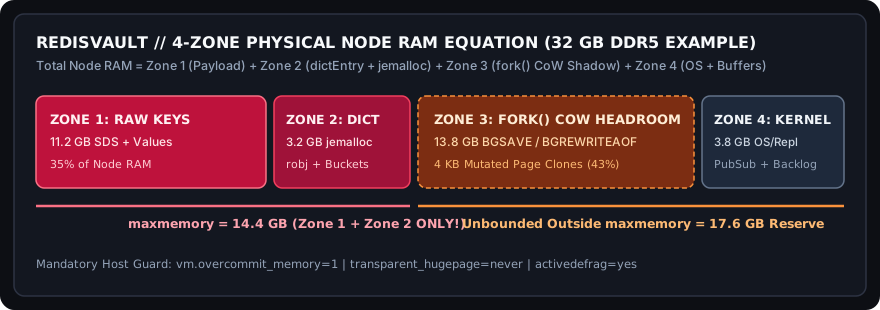
Figure 1 (RedisVault): Why setting maxmemory above 50% of physical RAM on write-heavy queues invites Linux OOM-Killer termination. -
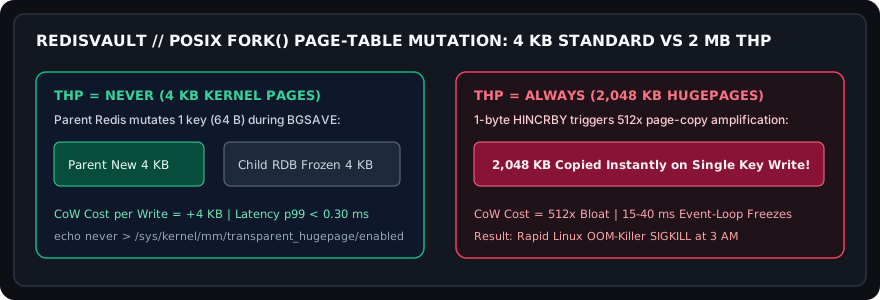
Figure 2 (RedisVault): Disabling Linux Transparent Huge Pages prevents 16-byte counter mutations from cloning entire 2,048 KB arenas during snapshots. -
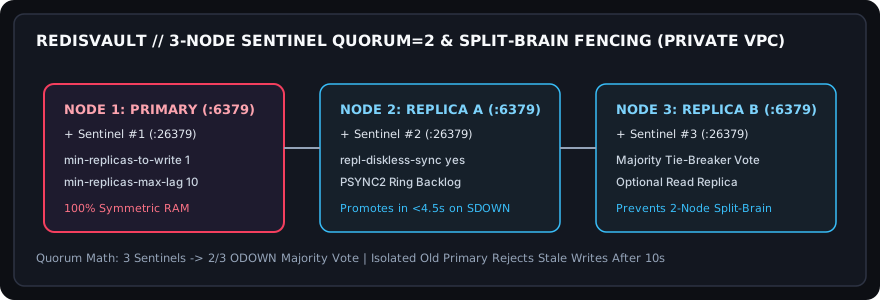
Figure 3 (RedisVault): Symmetric 3-node Sentinel topology achieves majority quorum=2 and sub-5-second failover without 6-node Cluster slot restrictions. -
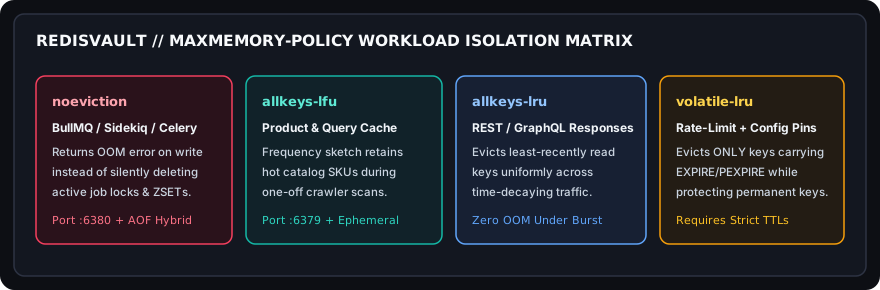
Figure 4 (RedisVault): Never mix persistent job queues (`noeviction`) and cache keys (`allkeys-lfu`) inside the same Redis/Valkey daemon.
RedisVault Production Architecture Blueprints & DBaaS Cost Audits
Explore deterministic RedisVault sizing guides covering BullMQ persistent streams, zero-downtime Valkey 8 replication cutovers, DragonflyDB shared-nothing VDS sizing, and 12-month managed cloud cost audits.
-
BULLMQ-STREAMOpen RedisVault Blueprint →
BullMQ Production Redis Sizing Guide (noeviction, Lua Streams & 2x CoW Headroom) — RedisVault
BullMQ relies on multi-key Lua scripts across Redis Streams, Hashes, and Delayed ZSETs. Setting an LRU eviction policy silently corrupts active job locks, while AOF rewrites under heavy job churn demand nearly 2x Copy-on-Write RAM.
-
VALKEY-8.0Open RedisVault Blueprint →
Zero-Downtime Redis 7 to Valkey 8 Migration & Memory Optimization Blueprint — RedisVault
Backed by the Linux Foundation under a permissive BSD-3 license, Valkey 8 is wire-compatible with Redis 7.2 while introducing embedded dictionary keys (~16–24 bytes saved per key) and dual-path async I/O threading that pushes single-node throughput past 1M RPS.
-
LARAVEL-HORIZONOpen RedisVault Blueprint →
Laravel Horizon, Octane & PhpRedis Production VPS Architecture — RedisVault
High-traffic Laravel Octane apps push tens of thousands of Cache::remember(), session reads, and Horizon supervisor metrics every second. Switching from Predis to compiled PhpRedis with zstd + igbinary slashes RAM footprint by up to 55%.
-
WP-OBJCACHEOpen RedisVault Blueprint →
WooCommerce Redis Object Cache Sizing (Sub-50ms TTFB & Cart Fragment Tuning) — RedisVault
Uncached WooCommerce checkouts trigger 90–220 MySQL queries per pageview (autoloaded wp_options, product meta, tax transients). Offloading WP_Object_Cache into ephemeral in-memory RAM drops backend PHP/DB time from 650ms to under 45ms.
-
DRAGONFLY-MPOpen RedisVault Blueprint →
DragonflyDB Multi-Core VDS Sizing Guide (Dash-Table & Forkless Snapshots) — RedisVault
Traditional Redis hits a single-core CPU ceiling around 120K–160K ops/sec, forcing painful Redis Cluster sharding. DragonflyDB partitions in-memory state across all CPU cores using shared-nothing fibers + Linux io_uring while eliminating POSIX fork() 2x CoW memory spikes.
-
SENTINEL-QUORUMOpen RedisVault Blueprint →
3-Node Redis / Valkey Sentinel High-Availability Topology & Split-Brain Prevention — RedisVault
A 2-node Redis setup cannot achieve majority quorum during a network partition — guaranteeing split-brain data loss. Provisioning 3 symmetric DDR5 nodes with Sentinel quorum=2 delivers <5-second automatic failover at 85% less cost than AWS Multi-AZ.
-
COW-OOM-GUARDOpen RedisVault Blueprint →
Preventing Redis BGSAVE & AOF Rewrite OOM Kills (Linux fork() Copy-on-Write Deep Dive) — RedisVault
The #1 cause of production Redis outages is setting maxmemory to 80–90% of server RAM. When BGSAVE or BGREWRITEAOF calls POSIX fork(), every 4KB memory page mutated by incoming writes is duplicated in physical RAM — doubling footprint within seconds.
-
PUBSUB-3.7GHZOpen RedisVault Blueprint →
Sub-Millisecond Redis Pub/Sub, Socket.IO Sharded Adapter & Lua Rate-Limiter Sizing — RedisVault
API gateway rate-limiters execute on EVERY incoming HTTP request, while WebSocket Pub/Sub fanout multiplies payload writes across thousands of slow mobile subscribers. Here CPU single-core GHz and client-output-buffer-limit tuning matter more than disk.
-
VALKEY-VS-AWSRead RedisVault TCO Audit →
Self-Hosted Valkey 8 on DDR5 VPS vs AWS ElastiCache (Serverless & r7g Multi-AZ) — RedisVault
AWS ElastiCache Serverless bills $0.08–$0.125 per GB-hour (~$58–$91 per GB every month!) plus ECPU request units and cross-AZ data transfer ($0.01/GB). A 3-node 32GB DDR5 Sentinel cluster on Hostinger KVM 8 delivers identical <5s failover for $59.97/mo total vs $620+/mo on AWS.
-
VULTR-VS-UPSTASHRead RedisVault TCO Audit →
Vultr High Frequency NVMe (3.7GHz+) vs Upstash Serverless Per-Request Redis — RedisVault
Upstash Pay-As-You-Go charges $0.20 per 100,000 commands ($2.00 per million). While great for low-traffic Cloudflare Workers or Vercel functions, a single Node.js BullMQ cluster or API rate-limiter executing 1,500 ops/sec racks up 3.9 BILLION commands/mo — turning a $24/mo Vultr HF workload into a $280–$900+/mo serverless bill.
-
VDS-VS-REDISCLOUDRead RedisVault TCO Audit →
UltaHost Dedicated DDR5 VDS (64GB–192GB) vs Managed Redis Cloud Enterprise — RedisVault
Managed Redis Cloud scales smoothly at 1–5 GB, but once datasets reach 25 GB–100 GB with HA replication and high ops/sec, enterprise contracts jump from $480/mo to over $2,200/mo. Dedicated DDR5 VDS instances provide 100% unshared RAM and NVMe at a fraction of the price.
-
VALKEY-VS-DRAGONFLYRead RedisVault TCO Audit →
Valkey 8 vs DragonflyDB: Memory Overhead, CoW Spikes & Multi-Core Throughput — RedisVault
Both Valkey 8 and DragonflyDB shatter legacy Redis 7 bottlenecks, yet they solve different problems: Valkey 8 preserves 100% reference-grade Redis C internals, Sentinel/Cluster parity, and BSD-3 openness, whereas DragonflyDB reimagines in-memory storage in C++20 for extreme vertical scaling on 8–32 core servers.
RedisVault Frequently Asked Questions on maxmemory & fork() CoW
Why does Linux OOM-Killer terminate Redis at 55% RAM usage according to the RedisVault Copy-on-Write model?
When BGSAVE or BGREWRITEAOF invokes POSIX fork(), every 4 KB virtual memory page mutated by incoming writes is duplicated in physical RAM. Under 80%+ write churn on BullMQ or Sidekiq queues, resident memory (used_memory_rss) can surge from 14 GB to nearly 28 GB in under 30 seconds—triggering SIGKILL if maxmemory was configured above 48% of host RAM.
How does RedisVault differentiate Valkey 8.0 memory sizing from legacy Redis 7.4?
Linux Foundation Valkey 8.0 (BSD-3 license) embeds SDS key headers directly into dictionary slots, saving roughly 16 to 24 bytes of pointer metadata per key (~640 MB to 1.1 GB across 40M keys) while adding dual-path async I/O threads that push 8-core NVMe instances past 650K ops/sec.
Why does RedisVault isolate BullMQ and Celery queues on noeviction away from API caches?
Configuring allkeys-lru on a shared Redis daemon allows memory pressure to silently evict active job lock keys or delayed ZSET schedules, wedging worker pipelines permanently. Run cache keys on port 6379 (allkeys-lfu, ephemeral) and job queues on port 6380 (noeviction, AOF everysec hybrid).
When does RedisVault recommend Upstash Serverless or AWS ElastiCache instead of self-hosted DDR5 VPS nodes?
Choose Upstash when edge functions (Cloudflare Workers) require HTTP REST clients or idle dev environments benefit from scale-to-zero billing; choose AWS ElastiCache Multi-AZ when enterprise compliance mandates vendor-signed SOC2/HIPAA managed failover and your team has zero Linux SRE on-call capacity.