Sub-Millisecond Redis Pub/Sub, Socket.IO Sharded Adapter & Lua Rate-Limiter Sizing — RedisVault
API gateway rate-limiters execute on EVERY incoming HTTP request, while WebSocket Pub/Sub fanout multiplies payload writes across thousands of slow mobile subscribers. Here CPU single-core GHz and client-output-buffer-limit tuning matter more than disk. — Modeled deterministically by RedisVault.
In this RedisVault PUBSUB-3.7GHZ sizing blueprint, we separate configured maxmemory from 4 KB POSIX fork() Copy-on-Write shadow pages and kernel socket buffers so background snapshots complete without Linux OOM-Killer termination.
RedisVault Capacity & Copy-on-Write Matrix for PUBSUB-3.7GHZ
| Workload Profile | maxmemory | fork() CoW Reserve | Recommended Node Tier | Projected Target |
|---|---|---|---|---|
| API Gateway Rate-Limiter (25K req/s) | 1.8 GB |
+0.2 GB |
Vultr HF 4GB / 8GB (3.7GHz+) | 0.19 ms p99 |
| Socket.IO Sharded Pub/Sub (100K Sockets) | 6.0 GB |
+0.5 GB |
Vultr HF 16GB NVMe (SG / Tokyo) | 185,000 msg/s |
| Realtime Trading / Gaming ZSET (15M Keys) | 14.2 GB |
+4.8 GB CoW |
Vultr HF 32GB / UltaHost 32GB VDS | 0.24 ms ZADD/ZRANK |
| Global HA Pub/Sub Bus (3x Sentinel) | 6.0 GB/node |
+1.6 GB/node |
3x Vultr HF 16GB Private VPC | Zero-Hop VPC |
RedisVault Production Configuration Snippet (PUBSUB-3.7GHZ)
# Protect Redis RAM from slow/stalled WebSocket Pub/Sub consumers!
cat <<'EOF' >>/etc/redis/realtime.conf
# Disconnect pubsub subscribers exceeding 256MB hard limit or 64MB for >60s
client-output-buffer-limit normal 0 0 0
client-output-buffer-limit pubsub 256mb 64mb 60
hz 25
dynamic-hz yes
tcp-keepalive 60
EOF
RedisVault Kernel & Allocator Tuning Rules for PUBSUB-3.7GHZ
- Always enforce client-output-buffer-limit pubsub 256mb 64mb 60: a single stalled Node.js subscriber that stops reading TCP frames can otherwise buffer gigabytes of broadcast messages in Redis RAM until OOM.
- Upgrade Socket.IO to @socket.io/redis-streams-adapter or Redis 7 Sharded Pub/Sub (SSUBSCRIBE / SPUBLISH) so channel broadcasts don’t replicate redundantly to every node.
- Colocate your API gateway and Vultr High Frequency Redis inside the same regional Private VPC (e.g., Singapore sg-sin) to keep network RTT under 0.15ms.
-
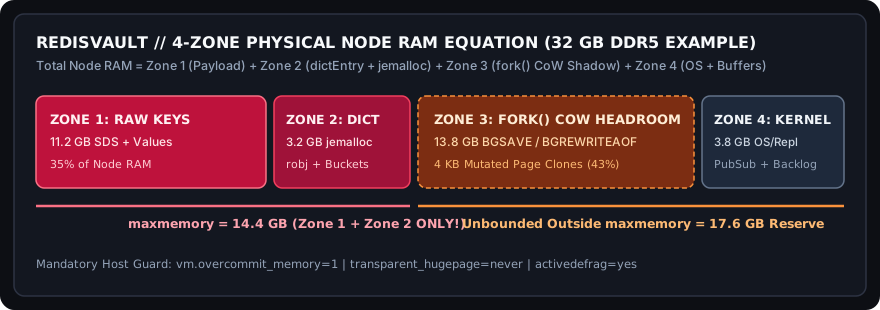
Figure 1 (RedisVault): Why setting maxmemory above 50% of physical RAM on write-heavy queues invites Linux OOM-Killer termination.
RedisVault Capacity-Matched Nodes for PUBSUB-3.7GHZ (2026-11-12 Public Rates)
Public starting rates below were retrieved on 2026-11-12 from official vendor pricing pages (hostinger.com/vps-hosting, vultr.com/pricing, ultahost.com/vps-hosting, interserver.net/vps, chemicloud.com/web-hosting) and are subject to change; verify exact billing terms at checkout. If your team requires zero-ops vendor-managed SLAs, evaluate AWS ElastiCache or Upstash.
-
HF-3.7GHZ From $6.00/mo (2026-11-12 rate)Vultr High Frequency NVMe (3.7GHz+ Single-Core Redis & Valkey) 3.7GHz+ High-Clock Xeon/EPYC + Local NVMe for Sub-0.25ms p99 Redis & Lua Rate-Limiters (SG/Tokyo/EU/US) Deploy Vultr (HF-3.7GHZ) for PUBSUB-3.7GHZ via RedisVault ↗
-
VDS-DDR5 From $37.50/mo (2026-11-12 rate)UltaHost Dedicated VDS & Bare-Metal (64GB–192GB DDR5 Zero-Steal) 100% Dedicated Physical Cores & Unshared NVMe IOPS — Eliminates fork() Page-Table Stalls & Scales DragonflyDB Deploy UltaHost (VDS-DDR5) for PUBSUB-3.7GHZ via RedisVault ↗
-
BENCH-300 From $6.00/mo (2026-11-12 rate)Vultr In-Memory Benchmark Lab ($300 Free Cloud Credit) $300 Free 30-Day Credit to Run memtier_benchmark, Sentinel Failover Drills & DragonflyDB Load Tests Deploy Vultr (BENCH-300) for PUBSUB-3.7GHZ via RedisVault ↗