Zero-Downtime Redis 7 to Valkey 8 Migration & Memory Optimization Blueprint — RedisVault
Backed by the Linux Foundation under a permissive BSD-3 license, Valkey 8 is wire-compatible with Redis 7.2 while introducing embedded dictionary keys (~16–24 bytes saved per key) and dual-path async I/O threading that pushes single-node throughput past 1M RPS. — Modeled deterministically by RedisVault.
In this RedisVault VALKEY-8.0 sizing blueprint, we separate configured maxmemory from 4 KB POSIX fork() Copy-on-Write shadow pages and kernel socket buffers so background snapshots complete without Linux OOM-Killer termination.
RedisVault Capacity & Copy-on-Write Matrix for VALKEY-8.0
| Workload Profile | maxmemory | fork() CoW Reserve | Recommended Node Tier | Projected Target |
|---|---|---|---|---|
| 5M Keys Migration (Replica Cutover) | 5.8 GB |
+2.0 GB CoW |
16 GB RAM (Hostinger KVM 4) | 280,000 ops/s |
| 15M Keys Multi-Thread I/O (io-threads 6) | 13.8 GB |
+4.4 GB CoW |
32 GB RAM (Hostinger KVM 8) | 640,000 ops/s |
| 40M Keys Enterprise Cache | 29.8 GB |
+9.5 GB CoW |
64 GB Dedicated VDS (UltaHost) | 920,000 ops/s |
| Sentinel 3-Node Valkey 8 Quorum | 13.8 GB/node |
+4.4 GB/node |
3x 32 GB KVM 8 ($59.97/mo total) | Zero-Downtime Sync |
RedisVault Production Configuration Snippet (VALKEY-8.0)
# Live Zero-Downtime Cutover: Attach Valkey 8.0 as a Replica of existing Redis 7
docker run -d --name valkey8 --network host \
  -v /data/valkey:/data valkey/valkey:8.0-alpine \
  valkey-server --port 6380 \
  --replicaof 127.0.0.1 6379 \
  --io-threads 6 --io-threads-do-reads yes \
  --maxmemory 14131mb --maxmemory-policy allkeys-lfu

# Verify master_link_status:up & lag=0, pause writes 500ms, then promote:
valkey-cli -p 6380 REPLICAOF NO ONE
RedisVault Kernel & Allocator Tuning Rules for VALKEY-8.0
- Valkey 8 embeds SDS key strings directly inside hash-table slot structures, trimming ~360 MB to 1.1 GB of pure pointer overhead per 40M keys automatically after full resync.
- Set io-threads to 70–75% of physical cores (e.g., 6 threads on an 8-core EPYC VDS) so socket read/write parsing runs concurrently without starving the command execution core.
- Test RDB compatibility first: Valkey 8 ingests Redis 7.0/7.2 RDB streams natively via REPLICAOF, enabling sub-second DNS/VIP cutover.
-
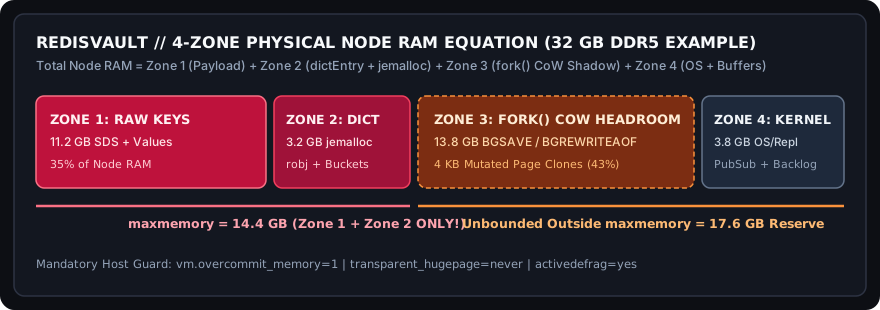
Figure 1 (RedisVault): Why setting maxmemory above 50% of physical RAM on write-heavy queues invites Linux OOM-Killer termination.
RedisVault Capacity-Matched Nodes for VALKEY-8.0 (2026-11-12 Public Rates)
Public starting rates below were retrieved on 2026-11-12 from official vendor pricing pages (hostinger.com/vps-hosting, vultr.com/pricing, ultahost.com/vps-hosting, interserver.net/vps, chemicloud.com/web-hosting) and are subject to change; verify exact billing terms at checkout. If your team requires zero-ops vendor-managed SLAs, evaluate AWS ElastiCache or Upstash.
-
DDR5-KVM8 From $4.99/mo (2026-11-12 rate)Hostinger KVM DDR5 NVMe VPS (Best RAM-per-Dollar for Valkey & BullMQ) Up to 67% OFF + Extra 20% Partner Discount • 8GB–32GB DDR5 ECC RAM for Full 2x BGSAVE CoW Headroom Deploy Hostinger (DDR5-KVM8) for VALKEY-8.0 via RedisVault ↗
-
VDS-DDR5 From $37.50/mo (2026-11-12 rate)UltaHost Dedicated VDS & Bare-Metal (64GB–192GB DDR5 Zero-Steal) 100% Dedicated Physical Cores & Unshared NVMe IOPS — Eliminates fork() Page-Table Stalls & Scales DragonflyDB Deploy UltaHost (VDS-DDR5) for VALKEY-8.0 via RedisVault ↗
-
HF-3.7GHZ From $6.00/mo (2026-11-12 rate)Vultr High Frequency NVMe (3.7GHz+ Single-Core Redis & Valkey) 3.7GHz+ High-Clock Xeon/EPYC + Local NVMe for Sub-0.25ms p99 Redis & Lua Rate-Limiters (SG/Tokyo/EU/US) Deploy Vultr (HF-3.7GHZ) for VALKEY-8.0 via RedisVault ↗